
November is American Diabetes Month, which makes it a fitting time to talk about a question we hear from patients and caregivers fairly often: could hyperbaric oxygen therapy help with a diabetic wound that is not healing?
The honest answer is that it depends, and it depends on specifics that require a real evaluation, not a general assumption. This is worth explaining carefully, because diabetic wounds are exactly the kind of situation where overpromising does real harm and clear, qualified information is genuinely more useful.
Why Some Diabetic Wounds Struggle to Heal
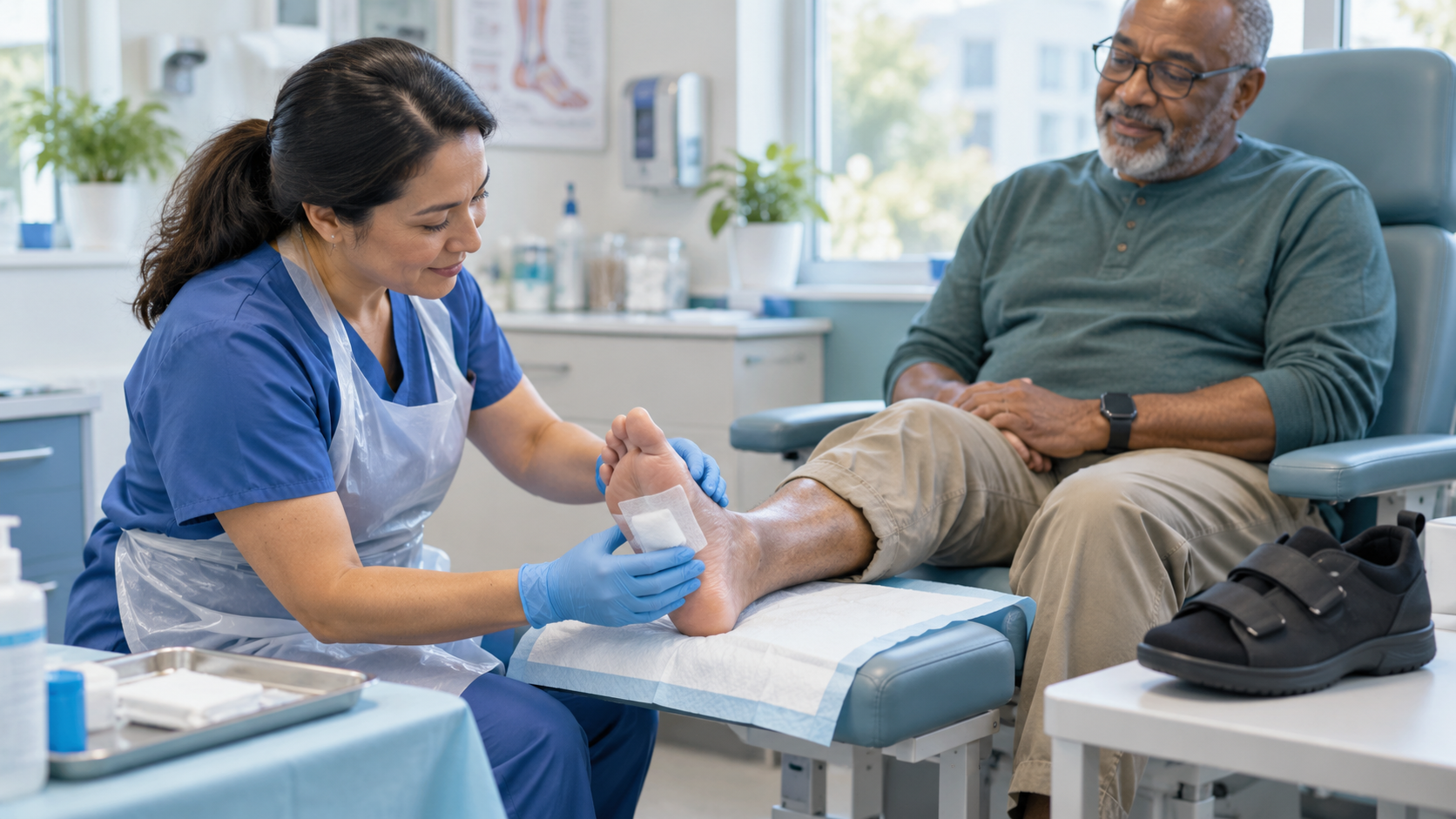
Diabetic lower-extremity wounds, particularly on the feet, can be affected by several overlapping factors. Reduced circulation can limit how much oxygen and nutrients reach the tissue that needs to repair itself. Nerve changes can reduce sensation, which can allow ongoing pressure or friction to interfere with healing without the person noticing right away. Elevated blood sugar can affect inflammation and infection risk, both of which influence how well a wound responds to standard treatment.
Standard wound care, which addresses pressure, dressing selection, infection risk, and offloading, is the foundation of treatment for these wounds, and it works for many patients. But for a subset of wounds, healing does not progress even with appropriate standard care in place, and that is where HBOT sometimes enters the conversation.
When HBOT May Be Considered

HBOT is not a first step, and it is not appropriate for every diabetic wound. It may be considered for certain diabetic lower-extremity wounds when specific criteria are met, generally including documented, appropriate standard wound care that has not produced meaningful healing progress over a defined period of time, along with a full clinical evaluation of the wound and the patient's overall health.
This is a deliberately narrow description, and that is intentional. HBOT is not a substitute for wound care, and it is not something that should be considered before standard treatment has had a fair opportunity to work. It is also not guaranteed to work for every wound that does qualify for evaluation. Not every patient is a candidate, and determining that requires a proper assessment rather than a general impression based on the type of wound alone.
What a Real Evaluation Looks At
If HBOT is being discussed for a diabetic wound, the evaluation typically considers the wound's history, its response to standard care so far, circulation status, infection risk, and the patient's overall medical picture, including other conditions that might affect candidacy for hyperbaric treatment.
This evaluation exists to protect patients from starting a treatment that would not meaningfully help their specific situation, and to make sure that when HBOT is used, it is being used appropriately, alongside continued wound care rather than instead of it.
What This Is Not
It is worth being direct about what this is not. This is not a promise that HBOT heals diabetic wounds. It is not a claim that oxygen therapy can replace circulation treatment, infection management, or offloading. And it is not a suggestion that every stalled diabetic wound needs a hyperbaric referral.
What it is meant to communicate is narrower and more useful: for certain diabetic wounds that have not responded to appropriate standard care, HBOT may be worth discussing as part of a broader treatment plan, and that conversation starts with an evaluation, not an assumption.
American Diabetes Month and the Bigger Picture
American Diabetes Month is often focused on blood sugar management, diet, and medication. Wound healing deserves a place in that conversation too, particularly for patients managing lower-extremity wounds that have not been improving despite consistent care.
If you or someone you are caring for has a diabetic wound that has not shown real progress despite ongoing wound care, it may be reasonable to ask whether an evaluation for HBOT makes sense. That question does not commit you to treatment. It simply starts the process of understanding whether HBOT belongs in the conversation for your specific situation.
Caregivers often play an important role in this process, since they may be the ones tracking how a wound has changed week to week. Bringing that information to a conversation about HBOT, alongside notes from the wound care team already involved, can help make the evaluation more complete.
If you have questions about whether HBOT may be appropriate for a diabetic wound, contact HyperbaricNC: https://www.hyperbaricnc.com/contact-us
Educational only. Not medical advice.
